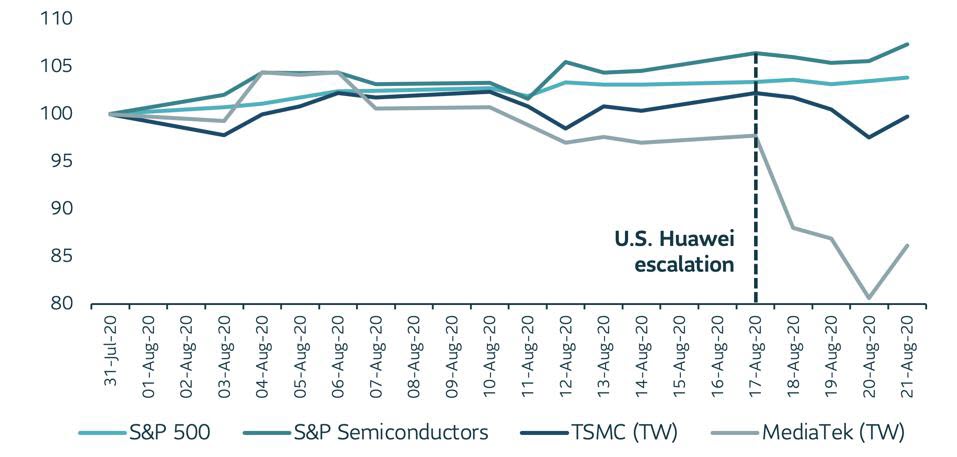
Technology independence remains a central concern. The U.S. has countered China’s long-brewing sovereignty claims with assertive technology demands, urging peers to boycott Huawei, banning popular Chinese apps and increasing transparency for U.S. listed Chinese companies. Surprisingly, the markets remain complacent. Seeming to ignore the threat of a bifurcation of global technology, and an estimated $3.5 trillion cost to the global information and technology sector over the next five years. So, what can investors anticipate in the fallout of the looming tech divide?
Tech Balkanization
This expanding confrontation could accelerate a bifurcation of global technology. Two global standards would entail competing internets, satellite and telecom networks, hardware and operating systems. For manufacturers and services operating globally, this would mean supporting both standards, and eliminating some economies of scale. In a hard break, there may be very little operability between the two. Further, it would reduce cross border investment, immigration and innovation.
However, neither side is willing to relent. The U.S. cites national security concerns to rationalize moves against Huawei and other Chinese technology players. Meanwhile, China has been unable to mitigate fears that big tech is independent from the state. As the odds of a complete tech divide become more likely, other countries urge some cooperation. America’s European allies feel the risks can be managed by excluding foreign suppliers from the most sensitive parts of a network and thoroughly vetting installations. But the U.S. is adamant there is no middle ground.
Global Tech Sector Losses
Apjit Walia, Global Head of Technology at Deutsche Bank, estimates that an all-out technology decoupling could cost the global information and communications technology sector over $3.5 trillion over five years. This staggering sum represents the loss of Chinese demand to Western companies, supply chain disruptions and the additional cost of adjusting to a world with rival standards. Approximately 60% of the overall hit would result from losing access to China’s market.
The cost is likely to be higher, as this estimate does not account for the countries that would align with China. Most Belt and Road partners would likely side with China, and Africa seems committed, as 80% of the continent is already powered by Huawei’s 4G network. The challenges for these regions to abandon Chinese technology are material: The complexity of Chinese supply chains, built over decades, would be costly to shift and reconfigure elsewhere. That transition could take 5-8 years. The lack of skilled labor and infrastructure in other locations is another major obstacle. Even as Chinese wages rise, superior productivity has been hard to match.
As noted already, there is the cost of a bifurcated world with two global standards. Decreasing economies of scale and any loss of operability between the two would be a headwind for global manufacturers.
Slowdown in Tech Development
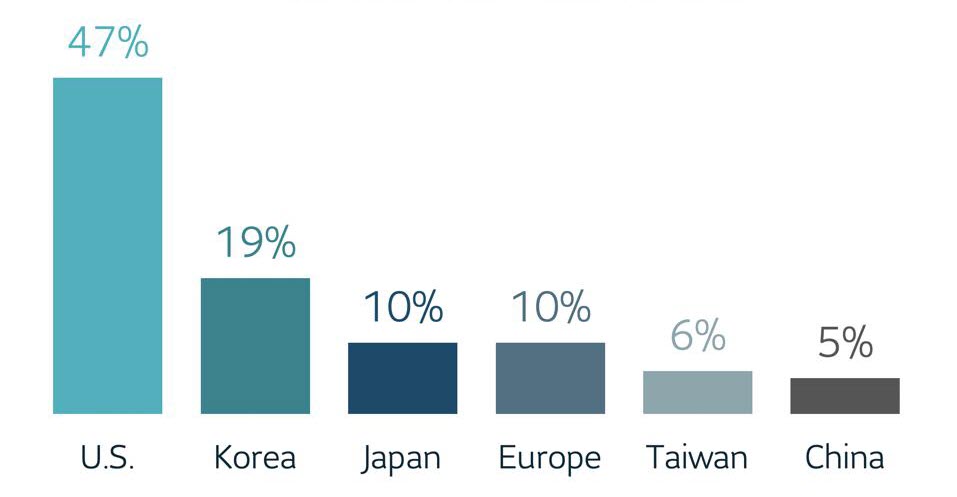
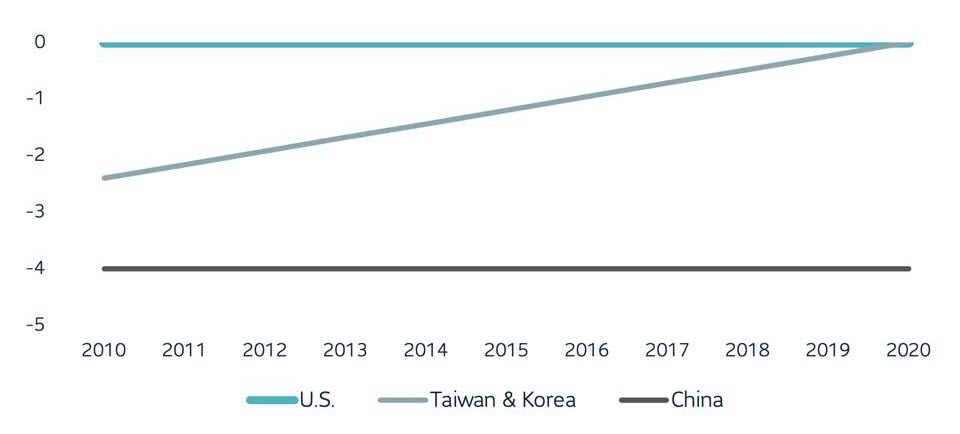
Semiconductors provide a prominent example of how the tech divide can hurt overall tech development. Currently, the U.S. dominates semiconductor development. Last year it accounted for close to half of global sales, with China a modest 5% by comparison.
2019 Global Sales Market Share