
Inflation isn’t just an economic risk. For insurers, it can become a balance-sheet challenge – affecting investment portfolios, claims costs, benefit obligations and long-term liability growth.
The challenges of this crisis are hitting with such intensity that it could hollow out vulnerable slices of the economy in as little as a few months. The early estimates are that the U.S. downturn, in the first half of the year, will be some of the worst back-to-back quarters for GDP on record.
Governments are launching record stimulus to avert a household and business cash crunch. The U.S. Senate approved a historic $2 trillion stimulus package last week, and additional stimulus, including infrastructure spending, is already under discussion.
However, doling out business grants and loans could take time, which will have a greater impact on small-to-medium sized businesses without access to cash reserves and credit lines. Smaller companies, which account for 44% of U.S. economic activity, also may not be as adept at navigating a cumbersome process as their larger peers. If these companies don’t get quick access to a lifeline to avoid insolvencies, mounting layoffs will hamper any chance of a speedy recovery.
A Severe Hit To Growth
Right now, there is nothing textbook about what’s happening. With approximately one-third of global consumers sitting at home, economic activity and corporate profitability over the next several months will look abysmal.
In scanning post World War II data, the worst back-to-back U.S. GDP quarters were in the heat of the financial crisis. In the fourth quarter of 2008, quarterly annualized growth dropped 8.7%, and in the first quarter of 2009 it was down 5.4%. Those will no longer be the low points. This year’s data will likely see back-to-back quarters of -10% and -25%.
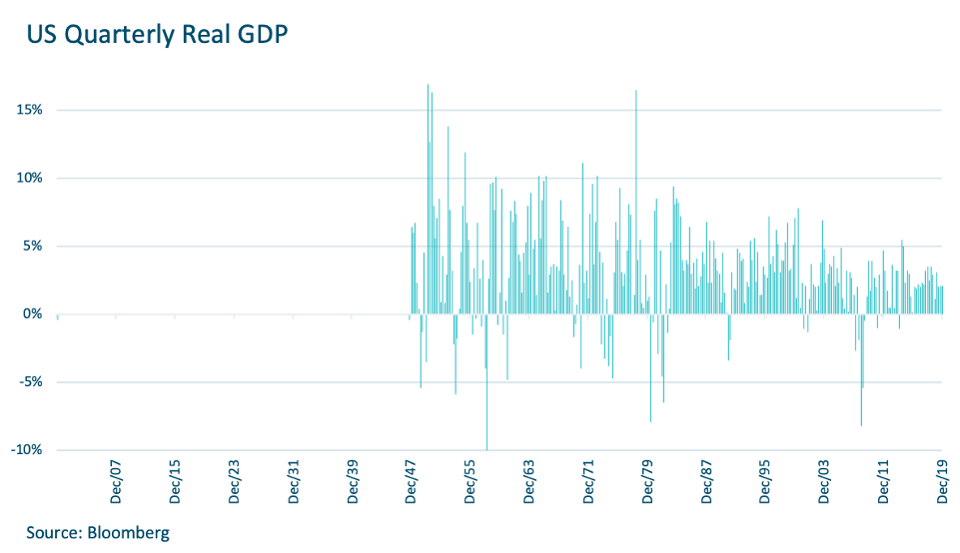
Early estimates are that the U.S. downturn, in the first half of the year, will be some of the worst back-to-back quarters for GDP on record | SLC Management
In the recent U.S. jobless claims data, over 3 million workers filed for unemployment. This historic deterioration is a conservative tally as self-employed and those in the gig economy are not included. Over the coming weeks, layoffs will accelerate and the unemployment rate could eventually spike somewhere between 12 and 15%.
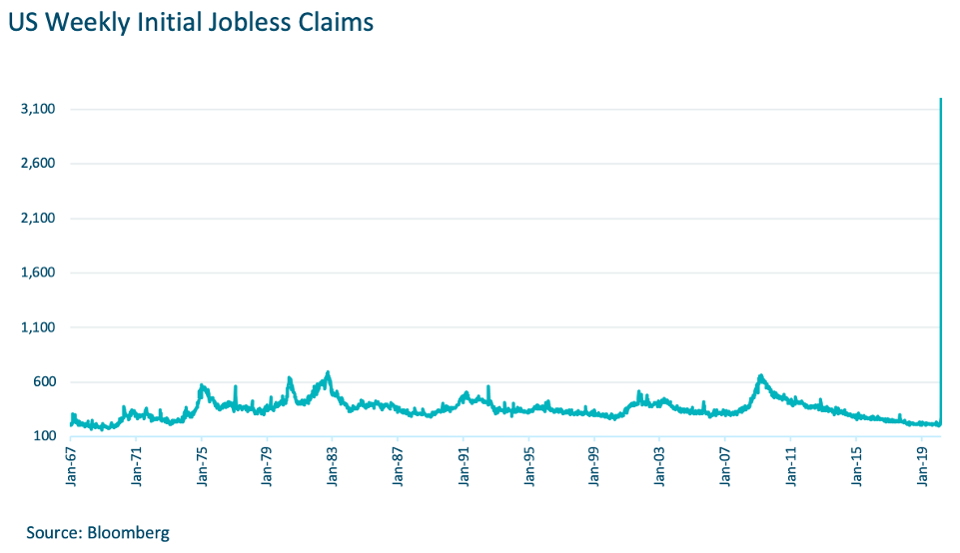
Over the coming weeks, layoffs will accelerate and the unemployment rate could eventually spike somewhere between 12 and 15% | SLC Management
The hope is that the summer months bring calm, with consumers starting to reengage and help stage a recovery. That certainly seems credible if social distancing flattens the infection curve and better testing helps with targeted containment. Nevertheless, a vaccine against COVID-19 is still 12-18 months away, even as countries and laboratories move rapidly to approve clinical trials.
In this scenario, where growth pummeled in the first half, if over the second half growth recovers at around 5%, it would still leave the full year down over 6%. For perspective, the worst GDP showing since the end of World War II was 2009 with growth down 2.5%.
However, if the third quarter is disappointing and the U.S. doesn’t turn until close to the end of the year, annual GDP could be down over 8% with unemployment off the charts.
Market Leaders Will Fare Better
If the economy is down somewhere between 6% and 8%, annual corporate earnings could be cut by one-third to a half.
As in most downturns, larger well-fortified companies have an advantage as markets tend to conclude they have more staying power. As an example, since the equity market peak on February 19th, the S&P 500 is down 24.9% through the end of March. But the top 50 companies by market value are down only 19.7% while the bottom 50 are down 51.8%.
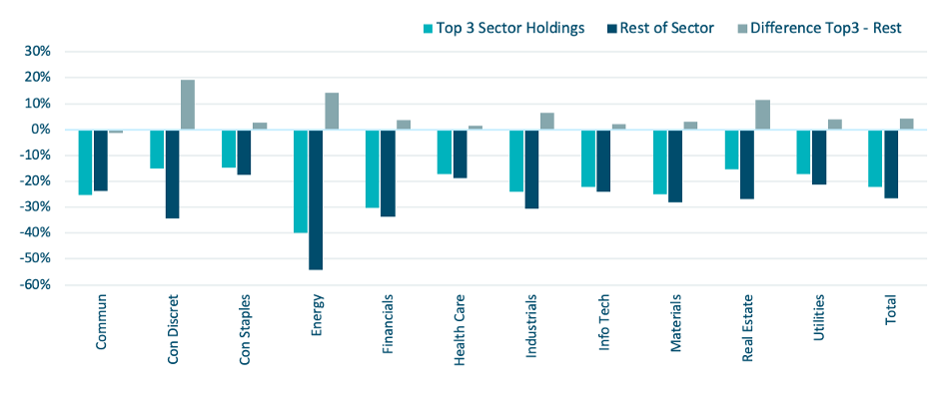
In a more robust measure of market leadership edge, a portfolio of the top three companies by market weight from each sector has outperformed the rest of the S&P 500 by 5.9% over the period from February 19th through March 31st.
S&P 500 Performance: Top 3 holdings versus rest of sector
From February 19, 2020 – March 26, 2020
Source: Bloomberg
These top three portfolios account for over 38% of the S&P’s market value. As the chart below shows, the top three have outperformed in all sectors with the most significant advantage in Consumer Discretionary, Energy and Real Estate.
Crises tend to favor the more resilient brands. Only the best equipped will be able to navigate the disruption of supply chains, limited consumer mobility and cash strapped household. The market seems to be signaling that already. The government needs to ensure that small businesses are quickly and effectively supported with stimulus packages.
The Next Great Depression?
All of this could seem to parallel the 1930’s when the U.S. struggled through a depression. However, the government at the time made a series of serious policy missteps that should be avoided this time.
As the Great Depression took hold, the Fed FDX raised rates and liquidity shrank by over 40% within a few years. Thousands of banks failed. And in a poorly timed blunder, the U.S. levied tariffs on over a dozen countries. That incited retaliation, eviscerated global trade and drove economic malaise that dragged on for years.
Today, global policy makers have learned the lessons of the Great Depression and the Great Financial Crisis and are moving with urgency and force. Most major central banks, in a matter of weeks, have slashed rates towards zero, rolled out significant quantitative easing and infused wide-ranging liquidity to keep markets moving. However, the most pressing challenge is to get stimulus distributed as soon as possible. And if follow up rounds are needed, policymakers need to act with conviction to protect small businesses as well as large ones so the jobless rate doesn’t soar.
This article first appeared in Forbes. This material contains opinions of the author, but not necessarily those of Sun Life or its subsidiaries and/or affiliates.